May 3, 2023
Unpacking the Conversation around Suicide (Trigger warning: descriptions of suicide attempts)
Sometimes, even to live is an act of courage. -Lucius Annaeus Seneca
Suicide is an ugly topic. It’s an ugly word, an ugly thought, and an ugly image. No one wants to think about it, because why would we? It’s depressing. Take a moment and think about your experiences with the concept of suicide, from people you may know to media portrayals. Have you spent a lot of time talking about it? Thinking about it? Probably not. Most of us don’t, unless it’s affected someone very close to us.
Truthfully, no one wants to talk about suicide, for reasons that are probably too many to unpack here. Not wanting to be disrespectful, not knowing what to say about it, or feeling ashamed are just a few, off the top of my head. Plus, who wants to bring up suicide? It’s not really a great conversation opener and, if you’re anything like me, you’re already not that much fun at parties.
The problem is that we really need to be talking about it. After all, each of us is really only a degree or two separated from someone who has attempted suicide, so whether it’s comfy for us or not, it’s definitely topical. Again, I’m not suggesting bringing it up at a party, during a happy hour, or on a first date. There’s a time, a place, and an appropriate forum for these types of things. But bottom line, most of us have known someone who has tried to commit suicide, or at least known someone who knew someone who tried… or even succeeded. And if you don’t think you do… well, surprise! I’m a two time suicide attempt survivor and I would imagine that, if you’re reading this, you and I are more than likely acquainted in one way or another.
“We’re all in this together. It’s okay to be honest. It’s okay to ask for help. It’s okay to say you’re stuck, or that you’re haunted or that you can’t begin to let go. We can all relate to those things. Screw the stigma that says otherwise. Break the silence and break the cycle, for you are more than just your pain. You are not alone. And people need other people.”
— Jamie Tworkowski
As I mentioned near the end of my previous post, “My Story,” around 70% of people with my condition, BPD, will attempt suicide at some point in their lives. Around 10% will succeed. Per the National Institute of Mental Heath (NAMI), “BPD patients have a mean of three lifetime suicide attempts, mostly by overdose [4].”
But suicidal thoughts don’t discriminate, and affect people afflicted with a lot of different conditions outside of just mine… Bipolar Disorder, Clinical Depression, PTSD, Schizophrenia, Chronic Pain… I could go on. Again, you probably know at least one or more people diagnosed with one of these, or another illness that carries a high likelihood of suicidal ideation or success.
“No one commits suicide because they want to die.” “Then why do they do it?” “Because they want to stop the pain.” -Tiffanie Debartolo.
I’m not going to spend a ton of time here unpacking suicide attempt rates, fatalities, and the demographics in which they occur. While I have spent a good amount of time researching those things over the years, and recognize that awareness of it is important if you’re a mental health awareness advocate, it’s not something I want to dive into here because 1) If you wanted to read a research paper, there are plenty of good ones out there, but that’s not why you’re here and, 2) there are already a lot of great resources that DO cover these things. Here are a few, if you’re interested:
- Suicide definitions, worldwide statistics, and risk factors: https://en.wikipedia.org/wiki/Suicide
- Suicide stats for the US: https://en.wikipedia.org/wiki/Suicide_in_the_United_States
- Facts about suicide: https://www.cdc.gov/suicide/facts/index.html
- Suicide in people with Borderline Personality Disorder: https://www.ncbi.nlm.nih.gov/pmc/articles/PMC6632023/
- Suicide in people with Bi-Polar Disorder: https://www.ncbi.nlm.nih.gov/pmc/articles/PMC6723289/
- Suicide in people with Post-Traumatic Stress Disorder: https://www.ptsd.va.gov/understand/related/suicide_ptsd.asp
- Suicide in people with Generalized Anxiety Disorder: https://www.ncbi.nlm.nih.gov/pmc/articles/PMC2940247/
- Suicide in people with Chronic Pain: https://pubmed.ncbi.nlm.nih.gov/24916035/
- Suicide in people with Clinical Depression: https://www.ncbi.nlm.nih.gov/pmc/articles/PMC6543655/
- Suicide in people with Schizophrenia: https://www.ncbi.nlm.nih.gov/pmc/articles/PMC2951591/
If you’re not a person who is interested in “scholarly articles” (no shame in that, by the way, a lot of folks aren’t), or are looking for some stats on a different condition not listed above, let me know in the comments, or PM me, and I can send you some other stuff. I could be here all day linking to relevant articles, but… I’m an impatient woman, and have other things to get to in this post, so just know that the above is by no means an exhaustive list – just some of the most common diagnoses linked to a high rate of suicide.
One positive thing I do see is that, over the last couple decades, suicide awareness is really starting to pick up steam. Just a quick Google search of “suicide rates” or “information on suicide” will yield this pop-up, even before showing any sites or links relevant to the search itself:
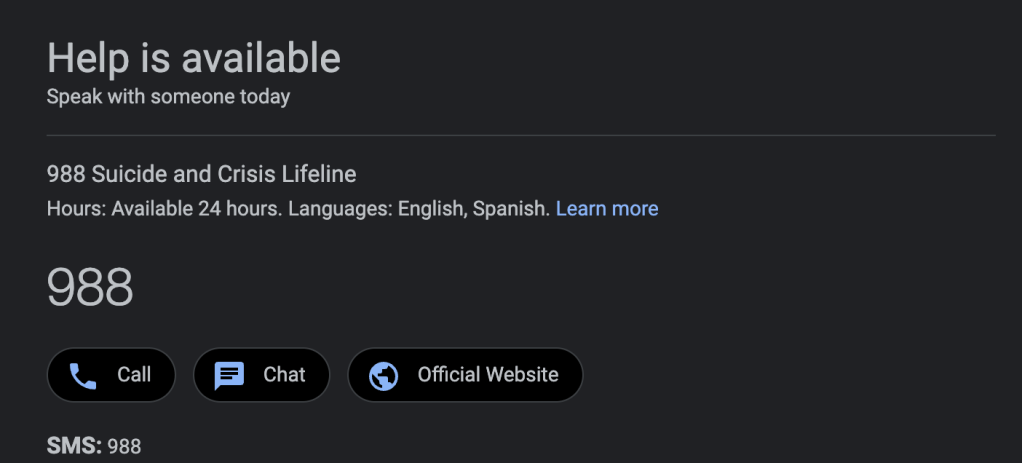
As an aside, I truly cannot express how happy it makes me to see this little pop-up when I Google this topic. It means we’re putting at-risk people first. Seeing “Help is available” as the first header before anything else when Googling this is such a powerful thing.
The rise of anti-bullying campaigns, movements toward general de-stigmatization of mental illness, and highly-publicized deaths of beloved celebrities like actor Robin Williams and Chester Bennington, lead singer of the band Linkin Park, by suicide in the past decade have really started to open up conversations. Conversions like, “Could this happen to someone I know?” “What would drive someone who *appeared* so happy to do such a thing?” and “What would push someone to the point where they felt there was no other way out than to end things entirely?” And I think we can all agree that these are good conversations to start having, albeit often super uncomfortable ones.
We’re sure not there yet, though. There are SO many ways in which we still have room to help bring awareness to, or de-stigmatize, the topic of suicide. Because as a society, we’re in trouble. Need more proof? No worries… I gotchu. Just take a look at this unsettling stat: “In a recent federal survey, more than 4 in 10 high school students reported feeling “persistently sad or hopeless,” while 1 in 5 said they’d thought about suicide.” (https://www.healthychildren.org/English/health-issues/conditions/emotional-problems/Pages/Which-Kids-are-at-Highest-Risk-for-Suicide.aspx)
That’s right – of today’s high school kids, 20% of them report that they’ve thought about suicide. 20%! Now, I’m no data analysis wizard but… it’s pretty clear that that’s a lot, any way you slice it. It sounds totally nuts, but I believe it because, as I alluded to above, I WAS one of those kids.
I was 17 years old the first time I attempted suicide. At the time, I was absolutely reeling from the recent deaths of two individuals very close to me, and anticipating, with dread, the inevitable, upcoming death of third, who was at the point of terminal illness. Everyone experiences these types of things, but already being improperly diagnosed with a mental illness for which I was also improperly medicated, stuff was snowballing real quick for me.
I woke up the morning of March 9, 2006. I had missed a ride to school because I had overslept, once again, due to the heavy sedative medication I was taking at the time. As I opened my eyes, sunlight streaming through the window, my brain said to me, “This is it. Today is a good day for you to die.” And for once, I didn’t fight it. I was tired of fighting.
I’ll pause here to explain why I’m telling you this. It’s to highlight the question I mentioned above that a lot of people ask when they hear someone has taken their own life: “What would push someone to the point where they felt there was no other way out than to end things entirely?” And that’s a question with a lot of answers, and it’s an important one, but the other question we should be asking is: “How long did it take for them to get to that point?” Because it varies – a lot. And it’s an important thing to understand as we continue to dive into not only the “why” of someone deciding to take their own life, but the “how long.” We can work on trying to eliminate common “whys,” like bullying, having no one to talk to, or not having access to the right medication or treatment, but it’s also important to understand the journeys of people who ultimately feel so haunted, hopeless, and pain-stricken that they end up at this place.
Some people, like myself, didn’t have a slow snowball roll to the point at which they finally said, ok man, I’m done. So long, cruel world. They also didn’t have one inciting incident that pushed them over the edge. One day they were just… there. And there was no singular, easily identifiable trigger. There was no slow lead-up. There are also the situations where we didn’t see it coming. “They were so talented!” “They were so funny!” “They were so on top of their game!” we say about people. But talented, funny, and successful people can be haunted too. That’s what makes it so unpredictable, and so hard to talk about. As humans, we’re programmed to want answers. We crave resolution. And the reason I think a lot of us don’t like to talk about suicide is because the conversation provides neither. There’s always, to some extent, a veil around suicide that shrouds the “why” of it, as well as the journey, in mystery. So we can’t get the answers we seek, nor can we give them.
But we can bring awareness. That’s within our power. Now. Today, I would challenge you to do one small thing to be the change and start a broader, more open conversation around this topic. Whether it’s clicking one of those article links above and reading about some stats and contributing factors, or whether it’s reaching out to someone and having a conversation (obvious, but obligatory disclaimer: always check with the person to confirm they are ok with a discussion on this topic), or even if it’s reaching out to me for a chat, just do it. It’s uncomfortable. I know it is. And it feels like a weird thing to do. But it’s really not. Because if you look at the rates above, and if they alarm you as much as they alarm me, it’s more important than ever.
A good friend of mine, also a suicide attempt survivor, has a tattoo of a semi-colon. That semi-colon symbolizes the partial or attempted stop, but also the continuation of life. It symbolizes that there is more to the statement; it just comes after. It’s not over; there’s more of the story to be told.
“It’s so much darker when a light goes out than it would have been if it had never shone.” -John Steinbeck
That’s all for today. See you tomorrow! Feel free to leave a comment, or PM me! Always here to chat, and always here to listen.
Your Friend in Mental Health and Wellness,
Laura

 Continue On
Leave a reply to Joyce Cancel reply